
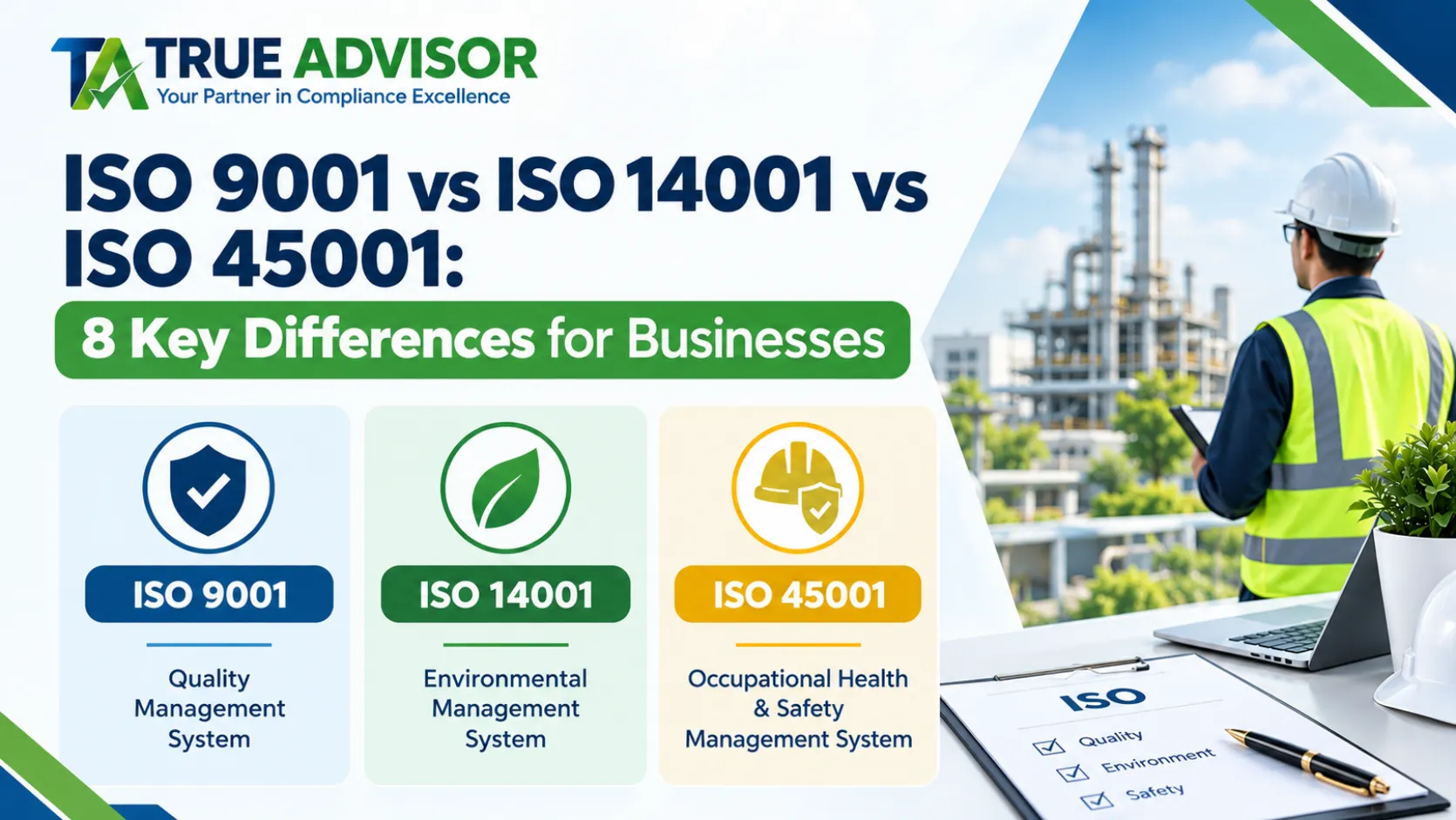
ISO 9001 vs ISO 14001 vs ISO 45001: 8 Key Differences for Businesses

ISO 9001 certification assists in managing quality and keeping customers happy. ISO 14001 helps you manage the impact of business operations on the environment. ISO 45001 focuses on safety and health concerns of workers serving in an organization. The real differences among the three are what each one asks you to look for, who it protects, and how you prove it works.
An ISO standard is an internationally recognized document that provides requirements, specifications, guidelines, or characteristics to make sure that a business’s products, services, and procedures are safe and of high quality.
Some of the widely used ISO standards are 9001, ISO 14001, and ISO 45001. All three help businesses enhance their overall operations, but carry a different purpose. For businesses that do not have an idea of which certificate they need first, this complete guide provides an overview of ISO 9001 vs ISO 14001 vs ISO 45001 and explains each side by side to show what changed in 2026.
Table of Contents
What is ISO 9001, ISO 14001, and ISO 45001?
These three ISO standards are the most commonly applied in the world at present. These standards define the set of rules and records a company must follow to keep its operations steady, planned, and safe. Moreover, the integrated management system ISO 9001, 14001, and 45001 also ensures that external auditor checks are smoothly carried out without regulatory errors. Here is a closer look at each standard:
- ISO 9001 Certification in India refers to a standard developed for quality management systems (QMS) that allows companies to satisfy customer requirements and meet legal requirements concerning services and products.
- ISO 14001 Certification stands for an environmental management system (EMS). It helps a business find, control, and reduce the overall effect of business operations on the environment.
- ISO 45001 Certification represents the basis for an occupational health and safety management system (OHSMS). The standard is designed to assist businesses in eliminating the occurrence of work-related injuries or illnesses.
Businesses of different sizes and forms can opt for these standards. A small bakery, a medium-sized IT company, and a large factory may use the same standard, though their systems may look different.
What Changed in ISO 9001 and ISO 14001 in 2026?
In 2026, ISO 9001 and ISO 14001 received updated editions to improve clarity and address evolving business and environmental needs.
ISO 9001:2026: Published on 16 September 2026, this edition replaces ISO 9001:2015. It maintains the focus on quality management and customer satisfaction while clarifying requirements related to leadership, risks, opportunities, and continual improvement.
ISO 14001:2026: Published on 15 April 2026, this edition replaces ISO 14001:2015. It strengthens guidance on environmental management, sustainability, climate change, biodiversity, and resource efficiency.
What should businesses do? Organizations certified to earlier editions should review the updated requirements, identify necessary changes, and consult their certification bodies about transition deadlines and arrangements.
ISO 9001 vs ISO 14001 vs ISO 45001: 8 Key Differences
Getting an overview of the differences between ISO 9001, ISO 14001, and ISO 45001 certification can help businesses understand the purpose, requirements, and other aspects of each standard. Let’s have a closer look:
1. Purpose Of Each Standard
The main aspect of difference between each standard is the purpose that each one is trying to address.
- ISO 9001 relates to quality. Its mission is to provide high-quality products and services that satisfy customer requirements over and over again with minimal waste and mistakes.
- ISO 14001 relates to the environment. Its mission is to decrease pollution, waste, and consumption of resources during business operations, and to comply with environmental legislation.
- ISO 45001 is about people or employees working in an organization. Its mission is to establish a safe and healthy working environment by finding and eliminating risks at an early stage.
An easy way to remember this is to say that the first standard is concerned with what you produce, the second standard is concerned with what you leave behind, and the third standard is about who is impacted when production is conducted.
2. What Each Standard Protects
While getting an overview of ISO 9001 vs ISO 14001 vs ISO 45001, businesses must understand that different standards prioritize different target groups.
- ISO 9001 certification in India emphasizes customers and those affected by the quality of your goods or services.
- ISO 14001 involves broader groups such as regulatory authorities, neighbours and local communities, environmental organizations, customers, as well as investors.
- ISO 45001 focuses on the employees of your organization, contractors, temporary workforce, and visitors to your premises.
An Integrated management system ISO 9001, 14001, 45001 helps businesses cater to each group well and conduct business operations in a more efficient and safe manner.
3. What To Identify First
One of the major similarities between ISO standards is the identification of issues during the initial stage. However, the issues you look for under each standard are different.
- For example, in the case of ISO 9001, this would involve specifying customer needs and pinpointing risks and opportunities that could interfere with fulfilling those needs, like late deliveries, defects in products, and unclear information.
- In connection with ISO 14001, one should consider environmental factors concerning activities carried out, like energy consumption, waste generated, emissions, water discharge, and chemicals stored. The ones with the most severe environmental impact are rectified.
- For ISO 45001, businesses have to identify hazards and risks in the area of OHS. In this case, a number of factors like moving machines, working at a height, noise, dangerous substances, long working hours, stress, etc. should be analyzed.
4. Laws and Rules Applied
Even if you are comparing ISO 9001 vs ISO 14001, or ISO 9001 vs ISO 45001, or ISO 14001 vs ISO 45001, all three standards require you to know the relevant laws and follow them. However, the relevant laws will not always be the same.
- In the case of ISO 9001, laws and rules apply to your product or service, e.g., rules concerning consumer protection and industry quality. Thus, during the audits, everything that relates to customer satisfaction is analyzed.
- ISO 14001 is related to environmental law, including waste management, air emissions, discharge permits, and chemical requirements. This standard uses the term “compliance obligations” to refer to these laws and obligations, including a whole bunch of promises that one makes voluntarily (for example, customer contracts).
- ISO 45001 is related to workplace health and safety legislation, including the legislation covering safety of equipment, training, injury reporting, etc.
What is important to understand is that if you receive your certificate, that does not mean you become fully compliant with laws. ISO 14001 and ISO 45001 help you manage your legal duties, but the law still applies in full. Your auditor checks only your performance in terms of your quality system but does not assess how satisfied all regulatory authorities are with your practices.
5. Requirements Of Each Standard
Take a closer at the differences between ISO 9001, ISO 14001 and ISO 45001 on the basis of key requirements;
- ISO 9001 puts special weight on customer satisfaction, control of suppliers and outsourced work, and how you handle products or services that do not meet requirements.
- ISO 14001 asks you to think about the life cycle of your product or service, from raw materials to disposal. It also asks you to prepare for environmental emergencies, such as a chemical spill or a fire.
- ISO 45001 requires you to consult and involve workers in safety decisions, not only managers. It also asks you to remove hazards first, before you rely on gloves or warning signs, and to investigate incidents to find the root cause.
The worker-participation rule in ISO 45001 surprises many managers. It means the people doing the job must have a real voice in how risks are managed.
6. Performance Measurement and Key Performance Indicators
Each of the ISO standards asks you to establish goals and track outcomes at regular intervals. Here are some of the performance indicators through which businesses can measure their success for the system:
| Standard | Measures |
| ISO 9001 | Customer complaints, on-time delivery, defect rate, repeat orders, customer satisfaction scores |
| ISO 14001 | Energy and water use, waste sent to landfill, recycling rate, emissions, spills or breaches |
| ISO 45001 | Injury rate, near-miss reports, days lost, safety training completed, corrective actions closed |
7. Business Benefits and Return on Investment
Depending on the requirements of a company, ISO 9001, ISO 14001, and ISO 45001 provide various advantages. These include:
- ISO 9001: Assists in reducing product faults, increasing customer satisfaction, and achieving stable quality.
- ISO 14001: Assists in minimizing waste production, conserving material, and controlling environmental hazards.
- ISO 45001: Assists in decreasing work-related accidents, enhancing employee health, and managing health problems.
In general, while these standards could help improve business outcomes, the actual results depend on how well the management system is developed and put into practice.
8. Implementation, Audits, and Certification
Even if the implementation of the three ISO standards is performed in a nearly identical manner, there are specific controls and documentation requirements for each standard.
A company must typically:
1. Determine the limits of the management system.
2. Identify potential risks and deficiencies.
3. Formulate processes and objectives.
4. Train its employees and do the documentation.
5. Perform internal audits and management reviews of the system.
6. Carry out external audits to get certification.
The integrated management system ISO 9001, 14001, and 45001 helps avoid redundancy in organizations in the best way possible.
What are the Similarities Between ISO Standards: ISO 9001 vs ISO 14001 vs ISO 45001
Apart from the differences, there are many significant similarities between ISO standards. Have a look:
- Similar Framework. All three use the same ten clauses: Scope, Normative References, Terms and definitions, Context of the organization, Leadership, Planning, Support, Operation, Performance evaluation, and Improvement.
- Plan, Do, Check, Act. Every standard is based on this cycle of improvement. Thus, businesses need to plan, implement, analyze, and act upon their regular operations.
- Risk-Based Thinking. You have to consider risks and opportunities instead of only responding to problems.
- Leadership: Top management has the accountability, and they ought to be involved rather than entrusting it to a Quality, Safety, or Environmental officer.
- Stakeholders. It is very necessary to find who your stakeholders are and what their expectations are.
- Continuous Improvement. Businesses must keep getting better and prove it with records.
Which ISO Certification Should a Business Choose?
When comparing ISO 9001 vs ISO 14001 vs ISO 45001, understand that the right certification relies on your business requirements, customer expectations, legal responsibilities, and risks in your business operations. There is no single standard that is best for every organization.
| Business Need | Standard to Consider | Why is it Suitable |
| Improve product or service quality | ISO 9001 | Helps control processes and meet customer requirements |
| Reduce waste and environmental impact | ISO 14001 | Supports environmental planning and performance monitoring |
| Improve employee health and safety | ISO 45001 | Helps identify hazards and manage workplace risks |
| Meets a customer’s quality certification requirement | ISO 9001 | May satisfy a specified supplier qualification requirement |
| Strengthen environmental management for supply chains | ISO 14001 | Helps demonstrate a structured environmental management approach |
| Improve safety controls at industrial or construction sites | ISO 45001 | Supports systematic management of workplace risks |
| Manage quality, environment, and safety together | All three | Allows an integrated management system |
Conclusion
The difference between ISO 9001 vs ISO 14001 vs ISO 45001 comes down to three business priorities: quality, environmental responsibility, and workplace safety.
ISO 9001 provides organizations with a framework for managing quality, while ISO 14001 assists them in managing environmental issues, and ISO 45001 supports keeping employees safe by recognizing hazards in the workplace. Businesses can use any of the three standards or create an Integrated Management System that includes all three of them. The decision will depend on their business goals, expectations from customers, and risks involved in their work processes.
At True Advisor, we help businesses identify potential gaps in their business operations and help them acquire ISO standards as per their requirements. Our professional team offers guidance and consultation at every stage and ensures that your business operations remain safe and efficient across every domain. So, are you confused about which ISO certification a business should choose? We are here to guide you.
Also Read: How to Choose a SEDEX Consultant in India: 7 Factors to Compare
Frequently Asked Questions (FAQs)
1. What are the main differences between ISO 9001, ISO 14001 and ISO 45001?
ISO 9001 focuses on product and service quality, ISO 14001 focuses on environmental performance, and ISO 45001 focuses on employee health and workplace safety.
2. Can a small business get ISO 9001, ISO 14001, or ISO 45001 certification?
Yes. Organizations of different sizes and across industries can implement these standards.
3. Can a company have all three certifications at the same time?
Yes. Many companies do have all three certifications as an integrated management system ISO 9001, 14001, and 45001. Because the standards share the same structure, you can build one integrated system and often combine the audits.
4. How long is ISO certification valid?
ISO certification, under common certification schemes, is valid for a three-year cycle, with periodic surveillance audits.
5. Can True Advisor help us with ISO 9001 certification in India?
Yes. True Advisor can help you acquire ISO 9001 certification in India. Our professional team evaluates gaps, suggests improvements, runs in-house audits, and prepares your business for the certification.