
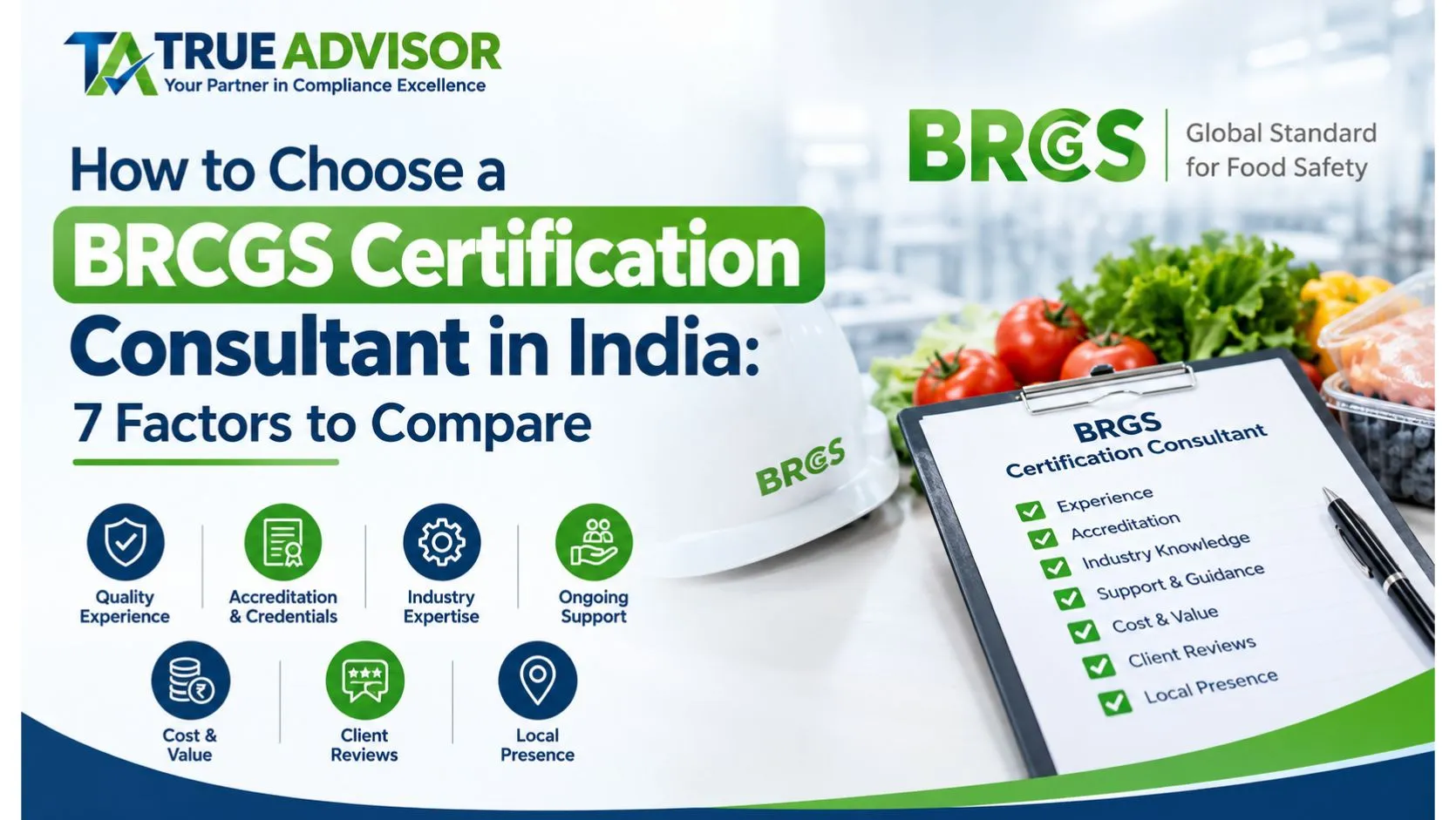
How to Choose a BRCGS Certification Consultant in India: 7 Factors to Compare

Choosing a BRCGS certification consultant in India involves evaluating credentials, food-sector experience, site-walk gap assessment, clear services, transparent costs, and after-audit assistance.
BRCGS certification is essential for food manufacturers, packaging companies, and other suppliers as it can help fulfill buyer requirements and enhance product safety in the best way possible. To acquire this certification, businesses need to follow a range of steps, from checking current practices to preparing documents and closing compliance gaps. The overall process can be challenging to navigate, which is why having the right BRCGS certification consultant in India can support businesses in making the overall process easier.
With so many consultants available, businesses need to choose the right partner to ensure a successful application and smooth partnership. This guide explains 7 factors to consider when choosing a consultant for BRCGS certification in India. Let’s take a closer look.
Table of Contents
What Is BRCGS Certification in India?
The BRCGS certification in India indicates compliance with the BRCGS Global Standard for Food Safety. The British Retail Consortium established this standard, and it is recognized by the GFSI, being highly sought after by retailers in the UK and Europe. The certification body approved by the BRCGS performs its audit of the facility and assigns it a rating ranging from AA to D based on the facility’s performance. The certification should be renewed every year; the status and rating of the facility can be checked by buyers in the BRCGS Directory of the public record.
Why Indian food businesses need it:
- Access to the market: Many private-label buyers and retailers from the EU and UK ask suppliers about this certification before offering them a listing.
- An acceptable grade for sale: A grade of A or AA sends out a positive signal to buyers that the company follows all the rules of the benchmark.
- Recognition by GFSI: GFSI compliance is acknowledged in all situations accountable to customers needing GFSI benchmarking.
- Less auditing: Retailers can rely on one graded audit instead of repeated inspections.
- Secure operations: Strict guidelines regarding the presence of allergens, foreign particles, and traceability help reduce complaints and recalls.
Choosing a BRCGS Certification Consultant in India: 7 Factors to Compare
Before you hire a BRCGS Certification Consultant in India, here are some of the key factors that businesses must consider. Have a brief overview:
1. Check BRCGS Credentials and Independence
In the beginning, verify the credentials. The BRCGS provides its network of partners with the names of approved consultants. Please check whether the consultant you intend to hire is present in this list and find out the details of the people on their team. But keep in mind that their roles are different: the consultant prepares the company, while a BRCGS certification body in India conducts an audit and issues the certificate. Never contact a company promising “to arrange” certificates without an audit.
2. Look for Food Sector Experience in India
BRCGS standards can cover rice, spices, fish, chips, ready meals, ls and other formats with differing risk profiles for each. Be sure to ask the consultant for the names of similar Indian plants that they have done and speak with these clients if you can. A BRCGS consultant in India familiar with export plants will be aware of many of the local factors, such as factory layout segregation, water quality, and staff training, and will be able to identify problems sooner.
3. Insist on a Site Walk Gap Assessment
BRCGS offers a self-assessment checklist, but a real gap analysis means walking your plant. The gap between ISO 22000 and BRCGS is mostly physical, such as fabrication, segregation, foreign-body controls, and allergen validation. A good consultant for BRCGS certification in India checks your site clause by clause against Issue 9 and gives a costed action plan, with building works planned first.
4. Compare Scope and Deliverables
Ask precisely what is included within the package. A comprehensive package usually includes team training and documentation like the HACCP plan and procedures, internal audits, and a mock audit that is evaluated like the real one. Obtain the scope in writing and identify who is responsible for writing the documentation and fixing the issues at the site. Some consultants offer guidance while you do the implementation; others do it for you.
5. Understand the Total Cost
The fee for consulting services is just one aspect when hiring for BRCGS certification in India. The overall consulting prices may vary from ₹ 90,000 to ₹ 3,00,000, plus certification body fees, around ₹ 40,000 to ₹ 60,000 for one small site, with additional upgrades. Always request a written quote detailing the consulting, auditing, training, testing charges, and repair costs, so you can compare the proposals easily.
6. Check the Timeline Is Realistic
Indian establishments take around four to six months from initial assessment to certification. For those who already have FSSC 22000 or ISO 22000, the process can take even less time. Following the audit, BRCGS requires that all non-compliances be solved within 28 days. The certificate is issued within 42 days after the audit. Do not trust those BRCGS consultants in India who promise you the certificate in a few days.
7. Ask About Support After Certification
BRCGS is an ongoing process that does not end with a single certification. Certificates usually need to be renewed yearly and have grades ranging from AA to D that are significant to buyers reading the grade. Therefore, you should ask your consultant about refresher training, internal audits, help with corrective action, and support in case there is an update of the standard. Continuous assistance helps you maintain your grade while being prepared, including in the case of surprise audits.
Conclusion
An affordable or fast BRCGS Certification Consultant in India is not necessarily the best one. The consultant that can demonstrate their competence, understands what you sell, inspects your facility, and provides a clear cost structure is the consultant that you need. Compare various consultants according to the seven factors provided in this article, ask for references, and verify every certification specified in the BRCGS Directory.
True Advisor is one of the best consulting firms to reach out to when it comes to BRCGS certification in India. We work with food businesses at every step of the process, starting from gap assessment to documentation to staff training to corresponding to mock audits and preparation for the final audit. We make the requirements easy to understand and provide support even after the audit is done. With us, businesses can be ready for the audit day and strive towards getting a good BRCGS grade.
Also Read: SMETA 2-Pillar vs 4-Pillar Audits: 7 Key Differences Suppliers Should Understand
Frequently Asked Questions (FAQs)
1. Is hiring a BRCGS consultant in India mandatory?
No. BRCGS states that if you feel the need for consultancy during preparation at your site and with your staff, you may obtain it.
2. What is the difference between a consultant and a certification body?
A consultant helps you to prepare for the certification, whereas a BRCGS certification body in India gets its auditors certified to carry out an audit and issue the certificate to you.
3. How do I confirm a certificate is genuine?
Search the site in the BRCGS Directory and check its status, grade, and expiry date.
4. How long is a BRCGS certificate valid?
Validity usually runs from 6 to 12 months, depending on your audit result, so a better grade means longer gaps between audits.
5. Can True Advisor help with BRCGS certification?
Yes. True Advisor can guide you through gap assessment, documents, training, and mock audits. The audit and certificate still come from a BRCGS-approved certification body.