
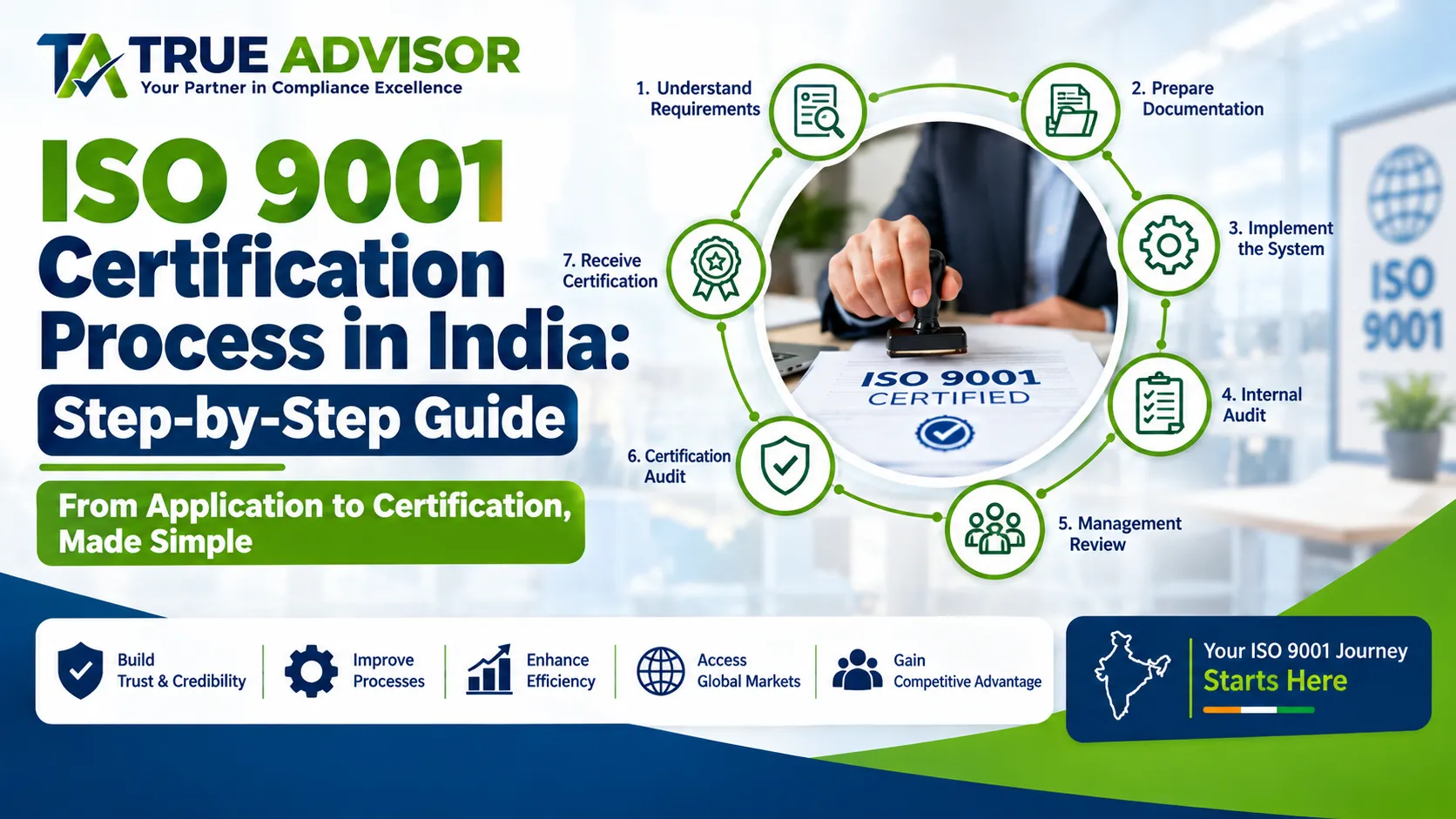
ISO 9001 Certification Process in India: Step-by-Step Guide

ISO 9001 certification process in India is a structured procedure that usually takes around 3 to 6 months, depending on the organization’s size, complexity, and readiness. The process involves implementing a Quality Management System (QMS), conducting internal audits, and completing an external certification audit by a certification body.
ISO 9001 is a globally recognized benchmark for setting up an effective Quality Management System (QMS) for businesses. Having this certification allows businesses to pursue significant projects and close potential deals. However, navigating the ISO certification steps can be challenging, with so many administrative tasks involved. This is where reliable ISO 9001 certification services in India from professionals help businesses achieve certification with proper planning and execution.
Through this comprehensive blog, let’s take a closer look at the ISO 9001 certification process in India, along with its meaning, benefits, tips, and cost factors to acquire it, and more.
Table of Contents
What Is ISO 9001 Certification?
First published in 1987, ISO 9001 is a globally recognized standard that specifies the requirements for a Quality Management System (QMS) in organizations. The key objective of this standard is to improve quality management in business operations and help organizations meet customer, statutory, and regulatory requirements. The latest edition, ISO 9001:2026, was published on 16 September 2026 and replaces ISO 9001:2015.
Moreover, ISO 9001 Quality Management System certification is available to businesses of any size, including small, medium, and large organizations. It provides evidence that an organization’s Quality Management System conforms to the applicable requirements of the standard and supports consistent quality management practices.
What Are the Seven Quality Management Principles Behind ISO 9001?
Before we understand the ISO 9001 certification process in India, let’s have a brief overview of the seven principles that act as a foundation for quality management. These include:
| ISO 9001 Principle | Explanation |
| Customer Focus | Understand customer needs and work to meet or exceed their expectations. |
| Leadership | Ensure leaders set clear goals, guide employees, and create a shared direction for quality. |
| Involvement of People | Encourage employees at every level to contribute to quality improvement and business success. |
| Process Approach | Manage related activities as connected processes to achieve consistent and efficient results. |
| Continual Improvement | Regularly identify problems, improve processes, and enhance the quality of products and services. |
| Factual Approach to Decision-Making | Use reliable data, evidence, and analysis to make informed business decisions. |
| Mutually Beneficial Supplier Relationships | Build strong relationships with suppliers to improve quality, reliability, and long-term business performance. |
ISO 9001 Certification Process in India: A Complete Overview
Businesses need to follow a complete set of ISO 9001 certification steps to demonstrate that their QMS meets the applicable requirements. Reliable ISO 9001 certification services in India from experienced professionals can assist in navigating these steps smoothly.
1. Preparation and Gap Analysis
Understand the Standard: The first step is to familiarize yourself with ISO 9001:2026, the current edition of the Quality Management System standard.
Conduct a Gap Analysis: Assess the current workings of your business processes against the ISO 9001 standard and identify gaps that need to be fulfilled.
Define the Scope: Determine which products, services, departments, or physical locations will be covered by the QMS.
Develop a Project Plan: To fulfill all the requirements, make sure to develop a timeline, a QMS team or coordinator, and budget resources.
2. Documentation of QMS
Draft Key Policies: Write a Quality Policy and establish measurable Quality Objectives.
Develop Required Documentation: Maintain the documented information required by ISO 9001 and any additional documentation necessary for the effective operation of the QMS.
Document Control: Create a method for managing document approvals, updates, access, and storage.
3. Implementation and Employee Training
Implement Processes: Introduce established methods and policies into your employees’ daily work practices.
Conduct Employee Training: Make sure that employees understand the applicable ISO 9001 requirements and their roles in the organization’s QMS.
Utilize QMS: Operate the QMS long enough to generate relevant records and demonstrate that processes are working effectively. The required period depends on the organization’s circumstances and the evidence needed for the audit.
4. Internal Audit and Management Review
Carry Out an Internal Audit: Conduct internal audits to assess whether the QMS conforms to the applicable ISO 9001 requirements and the organization’s own processes. Internal audits should be performed by competent and appropriately objective personnel.
Implement Corrective Actions: Take the necessary steps to address nonconformities identified during the internal audit and investigate their causes.
Management Review: Conduct a formal review of QMS performance by top management to evaluate its effectiveness and identify areas for improvement.
5. Select an Accredited Certification Body
Selecting a Certification Body: In India, choose a certification body accredited for ISO 9001 by the National Accreditation Board for Certification Bodies (NABCB) or another recognized accreditation body whose accreditation covers the relevant scope. Verify the certification body’s current accreditation status before proceeding.
Ask for a Quote: After considering the number of employees, locations, scope, and level of business complexity, the certification body can provide a suitable quotation.
6. The Certification Audit: Two Stages
Stage 1 (Readiness and Documentation Review): The certification body’s auditor reviews relevant documented information, assesses readiness, understands the organization’s scope and site conditions, and determines preparedness for Stage 2.
Stage 2 (Implementation Audit): The auditor evaluates how effectively the QMS is implemented. This may include reviewing records, interviewing employees, observing processes, and checking whether the organization meets the applicable requirements.
Address Audit Findings: If auditors identify nonconformities, the organization must address them and provide the required evidence in accordance with the certification body’s procedures. Certification is granted only after the certification body completes its review and makes a positive certification decision.
7. Issuance and Maintenance of Certificate
Obtain Certification: Once the certification body confirms that the applicable requirements have been met and makes a positive certification decision, it issues the ISO 9001 certificate. Certification cycles commonly run for three years, subject to the certification body’s rules and applicable accreditation requirements.
Surveillance Audits: Surveillance audits are generally conducted annually to verify that the organization continues to meet the requirements. The exact audit schedule is determined by the certification body.
Recertification: At the end of the certification cycle, a recertification audit is conducted to determine whether the certification can be renewed.
Note: Organizations currently certified to ISO 9001:2015 should consult their certification body about transitioning to ISO 9001:2026 within the applicable transition period.
ISO 9001 Certification Cost in India
The ISO 9001 certification cost in India depends on the organization’s size, number of locations, scope, complexity, audit duration, and certification arrangements. Consultancy and documentation support may also affect the total cost.
The following figures are indicative estimates and should not be treated as fixed or official certification fees.
| Certification Type / Business Size | Estimated Cost |
| Small Business (10–25 employees) | ₹30,000–₹75,000 |
| Medium Business (25–100 employees) | ₹75,000–₹1,50,000 |
| Large Business (100+ employees) | ₹1,50,000–₹3,00,000+ |
| Consultancy and Documentation | ₹20,000–₹80,000 |
| Annual Surveillance Audit | ₹8,000–₹30,000 |
Important: These estimates can vary considerably between providers and certification bodies. Request a detailed quotation that clearly separates certification audit fees from consultancy, travel, and other applicable charges.
Ready to Optimize Your Quality Management with ISO 9001?
The ISO certification process in India helps companies enhance their operations through quality management practices, thereby gaining the trust of their customers. Following appropriate steps allows companies to meet the ISO requirements and obtain more work opportunities. However, it is a time-consuming process to handle different requirements and documentation. The right partner can make the process easier.
TrueAdvisor is an experienced provider of ISO 9001 certification assistance for businesses of all sizes. Our professional team provides the necessary support throughout the ISO certification process, so it’ll be easy for you to obtain the certificate without excessive trouble and spend your time scaling your business. In addition, our team takes care of all the documentation, ISO 9001 certification steps, and more to ensure that your business operations align well with QMS without any potential gaps.
Also Read: BRCGS Certification Requirements: Process, Cost & Audit Preparation
Frequently Asked Questions (FAQs)
1. Is ISO 9001 certification mandatory in India?
No, ISO 9001 certification is not mandatory for every business in India. However, some clients, tenders, and contracts may require it.
2. Can a startup apply for ISO 9001 certification?
Yes, startups can apply for ISO 9001 certification, regardless of their size or how long they have been operating.
3. Which businesses can get ISO 9001 certification?
Manufacturing companies, IT firms, consultancies, hospitals, educational institutions, and service providers can apply for ISO 9001 certification.
4. Does ISO 9001 certification help win government tenders?
Yes. ISO 9001 Quality Management System can help businesses qualify for tenders that require this certification. However, it does not guarantee a contract, and each tender has its own requirements.
5. How can True Advisor help with ISO 9001 certification in India?
True Advisor can guide businesses through the ISO 9001 certification process in India, help them understand the requirements, prepare documents, and navigate the steps involved in getting certified.
6. What is the difference between ISO 9001:2015 and ISO 9001:2026?
ISO 9001:2015 is the previous edition, while ISO 9001:2026 is the current edition published on 16 September 2026. Organizations certified to the previous edition should consult their certification body about transition requirements and deadlines.
7. Who issues ISO 9001 certificates in India?
Independent certification bodies issue ISO 9001 certificates after evaluating an organization’s QMS. ISO itself does not issue certificates. Businesses seeking accredited certification should verify the certification body’s accreditation status and applicable scope.